Originally written by Wang Chuan. The English version below is a translation.
-
In descending order of importance: mental models, asking good questions, and solving problems.
-
What matters most is the diversity and flexibility of your mental models. If the underlying model is narrow or wrong, everything reasoned from it may be meaningless. One person sees Harvard as a prestigious university; another sees “a large tax-exempt hedge fund disguised as a school.” One sees Russia as a European power; another as “a giant gas station disguised as a country.”
See the author’s earlier article on how oil prices affect Russia:
- Wang Chuan: Who Was the Biggest Winner After the Oil Price Collapse Thirty Years Ago?
-
Asking questions: most people ask how to make money. A different way to frame the question is: “How can I reduce the time spent on things I dislike or do not care about to almost zero—and cover my living costs along the way?”
-
Solving problems comes last. Conventional education gives people similar, limited models and little initiative to pose new questions, so they crowd into solving the same problems. Crowding makes those problems harder and more expensive.
-
The old model of university says that attending a famous school provides a better network, job prospects, and future, so families push children toward elite admissions at any cost.
-
Another model observes that, for learning, the resources of any single university are now inferior to those of a rapidly growing, open, mostly free university requiring no entrance exam: the internet. A university can also bind a young person’s identity to one circle and create reflexive hostility toward other circles and models. For someone with strong inner drive who can build a network, university is no longer the only route. If work is widely recognized on social media or GitHub, how much does an elite credential still matter?
-
The old model of employment says that studying a profession at a good school produces a good job, good pay, and lasting happiness.
-
Another model sees a long value chain running from labor and materials to the paying end customer. A job means competing for a small, predefined segment of that chain—a “profession.” Employees often understand neither how value moves through the chain nor their own pricing power. A high salary creates false security and postpones contact with the hard work of winning customers. When layoffs shatter that security, finding a new position in the chain takes time. Understanding how value is created, transmitted, recognized, and captured reveals many paths that can be better than a conventional job. The core issue is where to stand in the value chain, not how to win an old, narrowly defined role with obsolete knowledge.
See the author’s earlier article:
- Wang Chuan: The Abstractor Works with the Mind; the Abstracted Works with the Body (Part I)
-
A single model forces the mind to solve a fixed class of problems. Once professionalized, the game becomes incremental optimization of a crowded field. When an ignored variable changes by orders of magnitude, the model itself changes and the old problem may cease to matter. A long window then opens in which new problems are easier and more rewarding to solve.
-
Why do people rarely change the underlying model and choose an easier problem? Peter Thiel distinguishes difficulty from value. Intense competition makes a prize hard to obtain, so people mistake difficulty for proof of value. Kissinger’s quip about academia—that battles are fierce because the stakes are small—captures the confusion. Perhaps participants cannot identify value directly, understand only difficulty as its proxy, or have romanticized competition.
-
Humans have a strong need for others to validate the meaning of what they do. Even an obviously valuable long-term pursuit feels lonely when few people share the belief, especially through uncertainty and setbacks. People therefore prefer a familiar, fiercely competitive battle with small but socially validated rewards to a lonely game under a new model where uncertainty is high, competition is low, and the possible reward is enormous.
-
Moving between models requires new underlying infrastructure. Infrastructure takes time and develops through reversals. When foundations change quietly, observers trained by the old model tend to ignore them.
-
Electric motors appeared around 1880. They were more efficient and flexible than steam engines, yet by 1900 only 5% of American factories used electricity. The transition took four decades because electric power required an entirely different factory layout and bodies of knowledge that neither electricians nor architects initially possessed.
-
In 1961, General Electric advertised that miniaturization was needlessly expensive: vacuum tubes were cheap, transistors costly, and buyers should ask whether portability was truly necessary.
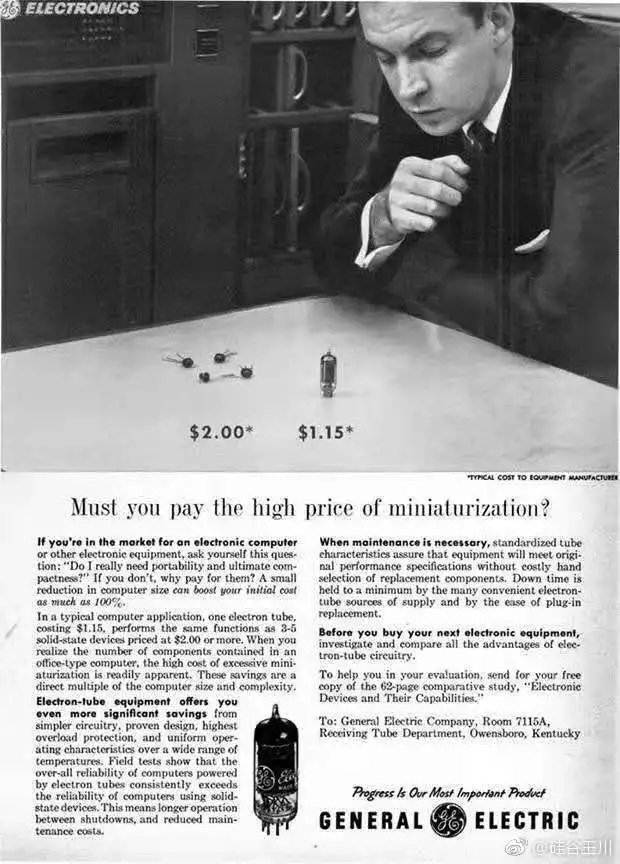
The irony was the slogan beneath it: “Progress is our most important product.” The argument assumed static prices. Large-scale transistor production soon reduced cost, while huge increases in component count enabled applications vacuum tubes could never support.
-
When office computers became widespread in the 1980s, productivity statistics showed little improvement. Robert Solow observed that computers were visible everywhere except in the productivity data. Early uses such as word processing did not directly raise output; measurement failed to capture convenience in finance and insurance; digital and paper systems operated together; installation and organizational change took years; and many projects failed. The paradox broke only in the late 1990s, when networked computers could exchange data and do things the old model had never imagined.
-
These examples suggest a model of model change:
-
A technology improves rapidly. Observers begin to see a new value chain replacing the old one. The change is not merely better parameters but a new ecosystem—networked computers, not faster typewriters; mobile applications, not merely email on a phone.
-
Progress remains slow while infrastructure is incomplete, and promised futures fail to arrive for years.
-
Practitioners of the old model mock poorly funded pioneers. Their arguments may be temporarily valid but ignore continuing development.
-
They measure the new world using old parameters. Early failures reinforce their prejudice.
-
Once the mind commits to a model, contrary facts often produce a more elaborate defense rather than correction: “If you torture the data long enough, it will confess anything.”
-
After the new value chain crosses a threshold, it flourishes suddenly and enables what the old model could not imagine. The old chain then collapses quickly. Investors should add to defensible leaders; newcomers should avoid confusing an industry tailwind with personal brilliance.
-
Many veterans refuse reality even after collapse. Experts can become childish and hysterical when a model to which they gave their careers disappears. They remind us not to repeat the error. As Paul Watzlawick observed, the emotional price paid for a solution can make us distort reality to fit it rather than change the solution.
-
Even veterans who face reality cannot compete immediately because they lack experience and position in the new value chain.
-
Without studying mental models and how they change, market participants pursue “value” as an unconscious instinct. Noise and anxiety reinforce that instinct, sending them from one irrational competition to the next.
(To be continued.)