This essay was written by the senior investor Five Trees and published on WeChat. The original is available in the cyqing archive. An individual investor has limited time and can research and follow only a limited number of investments in depth. Some diversification is necessary to prevent a black swan from destroying the portfolio—but how much is enough? The text below is the original author’s account.
Looking back at my investment history since 2012:
The period from 2012 to early 2015 was one stage. Holdings were highly concentrated—usually two or three companies, and sometimes only one. At the time, salary income covered household expenses, so this absolute concentration was manageable.
As the market heated up in early 2015, exposure fell rapidly and the cash portion was used mainly for arbitrage. This continued into the second half of 2015. The market was euphoric and indices kept rising; buying seemed always right and selling always wrong. Index futures frequently traded at premiums, and the market often offered liquid, effectively risk-free opportunities of roughly 1–3% per week. In retrospect that looks like money falling from the sky, but most participants dismissed it—otherwise the spread would have closed quickly. We kept reducing exposure, from more than 100% through bond-repurchase leverage to 100%, and then to about 10% by June. Thanks to this arrangement, the two crashes of 2015 did not hurt our net asset value. During the worst part of the crashes, it repeatedly reached new highs.
After the second half of 2015, attention gradually shifted to Hong Kong equities. Limited familiarity with the market, the memory of being burned by Boshiwa (01698) in 2012, and the loss of fixed income after resigning all reinforced a conservative mindset. Although I kept adding exposure after recognizing the opportunity, holdings were widely dispersed. Many positions were below 10%, or even 5%. By the third crash in early 2016, the fully invested portfolio held more than twenty stocks. This model is not necessarily wrong; an approach must fit the individual. The prominent Xueqiu investor Guan Wo Cai follows it and describes it as buying a broad basket of undervalued contrarian ideas. The logic is sound and the results have been good. I followed essentially the same model from late 2015 to early 2018. I bought many companies whenever the broad thesis seemed plausible, without reaching a deep understanding. I barely compared expected returns or opportunity costs and did not size positions according to differences in risk and reward. I scattered capital everywhere. The portfolio contained both major winners and poor performers, but each position was too small to matter much. Owning a huge winner in trivial size is painful. Although I did not lose money over those three years and the absolute return was respectable—roughly 100%—the approach increasingly felt wrong for me. It was not a model that suited me. I therefore began thinking more about concentration, diversification, and standards for buying.
What is diversification for? It protects the portfolio from the destructive effect of an idiosyncratic black swan. If the entire portfolio consists of one stock and that stock is Boshiwa, the result is catastrophic. Some diversification is therefore essential.
How much diversification is enough? Multiple academic studies of the US equity market show that when a portfolio reaches fifteen stocks, idiosyncratic risk approaches zero. We do not need to eliminate it completely, just as the air we breathe need not be 100% clean. Once a portfolio holds more than eight stocks, it can already eliminate roughly 90% of idiosyncratic risk. Our research suggests that in China’s equity market, five to ten stocks can remove more than 90% of idiosyncratic risk.
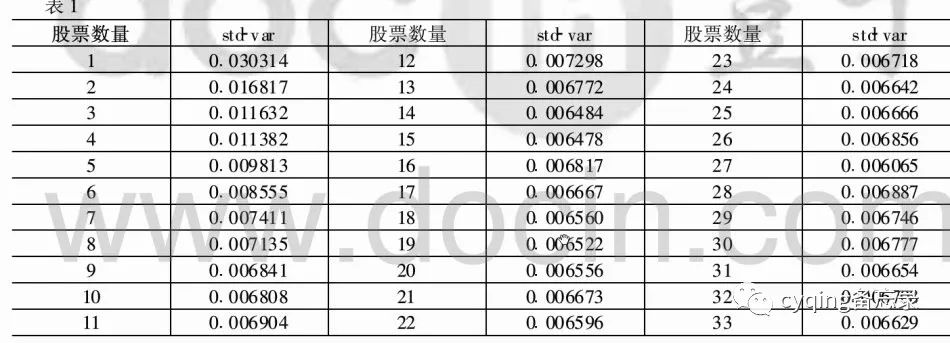
The italicized passage and table above come from “An Empirical Study of Diversification and Portfolio Risk,” by Jiang Maosheng and Zhang Xueli, published in the Journal of Dongbei University of Finance and Economics in November 2001. The table uses historical Chinese equity-market data and shows that once the portfolio reaches eight stocks, its standard deviation no longer declines materially. I have not independently verified the quantitative analysis, although mathematically inclined readers can do so. Overall, I consider the conclusion reasonable.
Why not diversify further? Consider Buffett’s classic 1965 discussion: “Frankly, if fifty different investment opportunities were available to me, each with a mathematical expectation of outperforming the Dow by fifteen percentage points a year, that would be ideal. If the fifty opportunities were uncorrelated, I could divide our capital into fifty equal parts, invest 2% in each, and sleep soundly because our overall performance would almost certainly approach fifteen points above the Dow. Reality is different. After a great deal of hard work, we can identify only a handful of opportunities that are especially likely to make money. Under our objective, I require such an opportunity to have a mathematical expectation of outperforming the Dow by at least ten points. There are not many such opportunities, and even among those we find, expected returns differ enormously. We must always answer this question: ‘How much should be allocated to the idea ranked first by expected relative return, and how much to the one ranked eighth?’ The answer depends mainly on the difference between their expected returns and on the probability that the first could produce an extremely poor relative result. Two stocks may have the same expected return, but one may have a 5% chance of trailing the Dow by more than fifteen points while the other has only a 1% chance. The wider range of outcomes in the first would reduce my willingness to concentrate in it.” Buffett’s point is simple: there are not enough opportunities with equally high expected returns.
From the perspective of reducing idiosyncratic risk, the benefit declines very slowly—or barely at all—after a portfolio reaches eight or ten stocks. There is no need to diversify beyond that point. Excess diversification lowers expected portfolio returns while doing almost nothing further to reduce idiosyncratic risk.
In summary: five to eight stocks provide adequate diversification. When expected returns are exceptional and the probability of loss is low, three to five may be enough. Only concentration makes it possible to own listed-company equity as you would own a business that might never be listed.