Three Core Questions About Pendle
- How large is the market opportunity in Pendle’s industry?
- Can Pendle maintain its competitive advantage and leading market share?
- How do tokenholder interests relate to the state of the business?
How Large Is Pendle’s Addressable Market?
Pendle can split any yield-bearing underlying asset into two components, YT and PT. YT appeals to speculators willing to accept higher risk in pursuit of higher returns, while PT appeals to buyers seeking lower risk and fixed returns. The business resembles an interest-rate swap (IRS) in traditional finance, with several uses:
- Interest-rate hedging: an institution may have fixed-rate debt but want floating-rate exposure, or it may want to convert floating rates into fixed rates to plan cash outflows.
- Lower financing costs: borrowers face different rates in different markets, and using comparative advantage can reduce their combined borrowing cost.
- Speculation: traders express a view on the direction of interest rates and seek to profit from it.
The size of the traditional interest-rate swap market
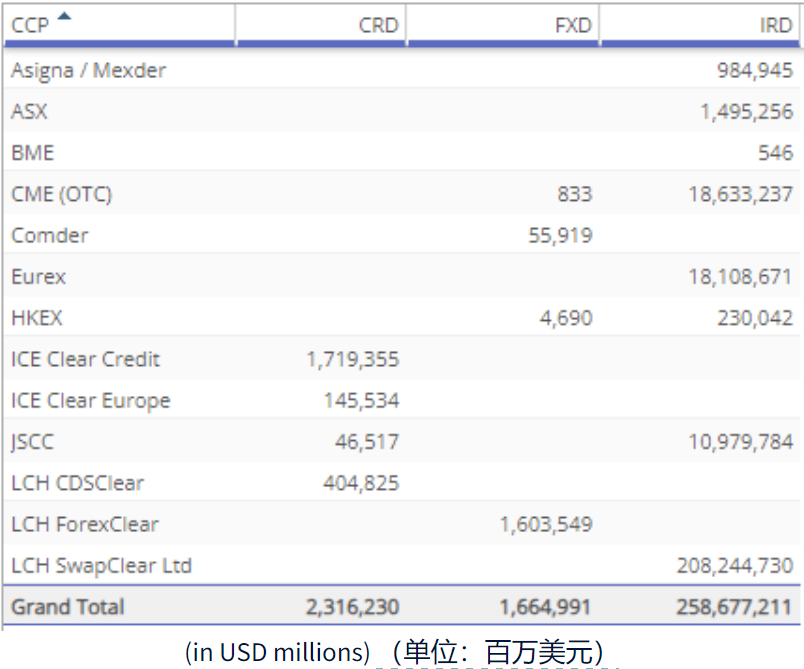
An ISDA report states that interest-rate derivatives trading volume reached US$292.8 trillion in 2022, up from US$231.2 trillion in 2021. Interest-rate swaps are traded over the counter, mainly through SEFs such as CME in the United States and MTFs such as the London Stock Exchange Group’s LCH in the United Kingdom. The chart below shows outstanding notional value by clearing house at the end of June 2023. LCH was the largest, with 80.5%, followed by CME at 8.9% and Eurex at 8.7%.
The addressable market for crypto interest-rate swaps
Any estimate of Pendle’s potential market size depends on many weak assumptions. For example, applying the ratio between traditional IRD markets and futures or equity markets is not a suitable comparison for Pendle. Even so, comparing the US$292 trillion notional IRD figure with global GDP of about US$101.3 trillion in 2022 gives a rough sense of the potential scale of an IRS-like business.
Even if direct comparison is poor, we can reason qualitatively about Pendle’s opportunity. Three conditions support growth in trading volume for an interest-rate exchange business like Pendle:
- Growth in yield-bearing crypto assets: increases in assets such as aUSDT on Aave, stETH, and DEX LP positions create more potential listings for Pendle.
- Volatile yields: if yields do not move, demand for Pendle declines.
- Difficulty predicting the direction of yields: if yields move predictably in one direction—as stETH yields might while ETH staking supply rises—users will simply buy and hold PT rather than generate recurring trading demand.
Crypto’s central innovation is decentralized value storage, and wherever money exists, people search for yield. Growth in yield-bearing assets ultimately depends on whether the crypto industry can attract more outside capital. Judging the first condition therefore requires confidence in the industry; I will not elaborate here on why I am optimistic.
Yield volatility and forecasting difficulty should persist for a long time in crypto, and both are necessary for an interest-rate swap business. Beefy’s yield pools illustrate the main types of on-chain yield assets. One category is staked ETH derivatives such as stETH, whose underlying yield comes from Ethereum’s consensus and execution layers. Another is DEX LP tokens, and a third is lending receipts. stETH-type yields are relatively stable, while LP and lending yields move substantially with market conditions, supply, and demand. More recently, point-farming projects have created another class with volatile, highly unpredictable yields. Their popularity expands the opportunity for interest-rate swaps.
Can Pendle Maintain Its Competitive Advantage and Leading Share?
We can examine competition today, but the future market structure can only be understood as it develops.
Competitive structure in interest-rate swaps
Traditional finance shows that LCH controls 80% of outstanding notional value in interest-rate swaps, while CME, Eurex, and JSCC in Japan account for another 18%. This is an oligopoly. The primary reason is the powerful network effect in trading: participants create a pool of liquidity, and better liquidity attracts more participants, deepening the moat and pushing out competitors.
In traditional finance, exchanges generate excellent cash flow, are often partly controlled by governments, and benefit from regulatory moats that strengthen monopoly effects. In crypto, offshore centralized exchanges such as Binance and OKX and on-chain exchanges such as Uniswap and Curve compete without a regulatory moat. Competition is intense, making liquidity the most important factor. Competitors at a liquidity disadvantage have few options other than differentiated positioning—for example, focusing on perpetual contracts rather than competing head-on in spot markets. Once an industry matures, a liquidity moat creates enormous pricing power and durable, high-quality cash flow.
Competition in crypto interest-rate swaps
Crypto itself is still developing, so its interest-rate swap market is at an even earlier stage. Pendle is currently the only scaled operator. Simon Jones, founder of the now-closed Voltz protocol, describes the difficulties of the business in “Why DeFi interest rate swaps may be the next frontier of finance.” Within crypto alone, Pendle’s market position is even stronger than LCH’s in traditional swaps.
Competitors are almost certain to emerge in an early industry. That will test the team’s operating ability: efficiency, resource allocation, and selection of underlying assets. At this stage, competitors also have more opportunities to differentiate—for example, by serving chains or asset types Pendle does not cover.
From a capital-allocation perspective, interest-rate swaps have an excellent business model and the prospect of strong cash flow. Investors who did not back Pendle will probably fund and support competitors. A period of intense competition is foreseeable, including fee wars and battles for liquidity.
Spectra Finance, formerly APWine, was still in testing and had completed a partial audit. Its mechanism is broadly similar to Pendle: PT and YT remain, while SY is called an IBT, or Interest Bearing Token. Its token is APW, with an FDV of about US$41.5 million as of March 2024. It may become a formal Pendle competitor, making its launch, development, and effect on Pendle worth watching.
YT’s current leverage comes from PT, but the protocol as a whole does not use capital leverage. Traditional interest-rate swap markets, by contrast, operate with high leverage. More capital-efficient protocols may eventually compete, although leverage depends on assumptions about credit; implementing it in trustless DeFi is a separate problem.
Tokenholder Economics and the State of Pendle’s Business
$PENDLE holders obtain the most important rights by locking tokens as vePENDLE, which grants a share of pool fees. Because longer PENDLE locks produce more vePENDLE, liquid-wrapper projects are likely to emerge. The chart below shows Pendle’s fee-distribution channels and why locking PENDLE to obtain vePENDLE is the primary route.
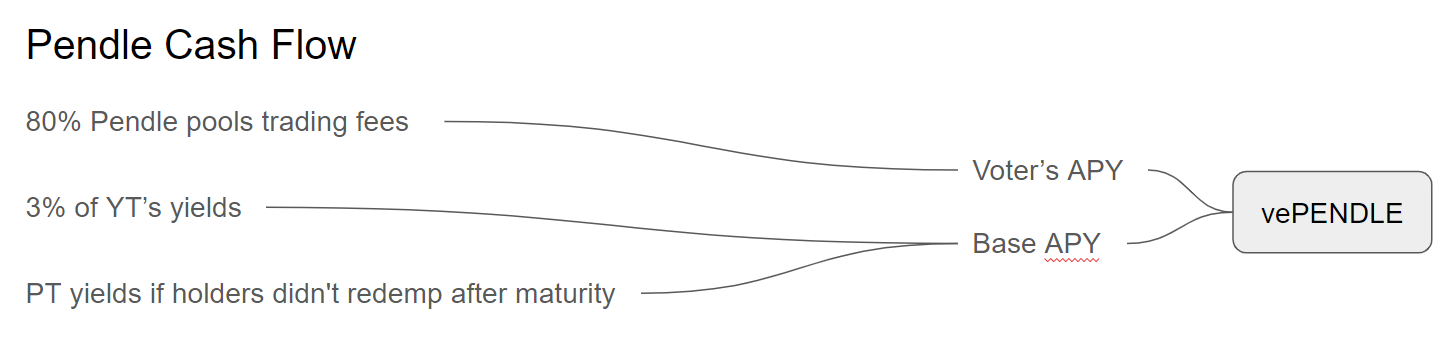
Consider the potential direction of Pendle’s three cash-flow sources. First, set aside the third category: PT yields. It comes from PT holders forgetting to redeem after maturity; if market participants are rational, they should not make such a basic mistake.
YT yield comes from returns on the underlying assets and currently contributes little. As crypto adds more yield-bearing assets, however, this source could generate meaningful cash flow. Its two key indicators are TVL and underlying-asset yields, both of which have substantial growth potential as crypto expands.
Trading fees are currently the main source of cash flow and should remain the central economic benefit for Pendle holders. Trading volume is therefore the most important metric to watch.
An unreliable cash-flow outlook for Pendle
Start with conditions in March 2024. With “Double Count” selected in DeFiLlama—appropriate because Pendle serves yield-bearing derivatives—the combined TVL of Ethereum and Arbitrum was US$111.39 billion. In most cases, locked capital has a corresponding yield-bearing asset, such as a Uniswap LP position.
Around March 20, 2024, Pendle’s TVL was approximately US$2.35 billion, or 2.11% of total TVL across the two chains. Daily volume was roughly US$225 million, or 9.6% of protocol TVL.
Using deliberately unreliable assumptions, consider Pendle’s revenue five years later:
- Ethereum and Layer 2 networks reach US$1 trillion in TVL.
- Pendle captures 10%, or US$100 billion in TVL.
- Average daily volume equals 5% of TVL—below the temporarily elevated level caused by point programs and boosts in late March 2024—or US$5 billion per day and US$1.825 trillion per year.
- Fees average 5 basis points, producing US$910 million in cash flow, slightly above the traditional interest-rate swap business.
Many details are unexplored and the assumptions are highly subjective; this is only a rough directional exercise. Cash flow could diverge enormously if, for example, a competitor emerges on Ethereum and Pendle fails to expand there, or if Pendle maintains the current competitive structure and charges much more than 5 basis points.
Bottlenecks in Pendle’s business development
Launching a Pendle market requires negotiation and cooperation with the underlying yield-bearing project. This is especially true for point programs, where point calculations depend on the partner. Pendle therefore requires unusually strong operations. The speed of its market launches already demonstrates a highly effective team, but expansion still resembles manual token listings on a centralized exchange: markets cannot list themselves, limiting short-term growth. Point programs also require partners to recognize YT tokens when calculating points, creating integration risk.
Over the long term, Pendle will likely use DeFi’s AMM mechanism to build a permissionless market protocol and shift part of the operating burden to partner projects.
Tailwinds and headwinds
This article was written in the first half of 2024, when the market was rapidly recognizing Pendle’s value and optimistic descriptions of its strengths were common. I share the optimism about crypto’s growth potential, the moat around interest-rate swaps, Pendle’s first-mover advantage, and the team’s strong competitiveness and execution. Together, these factors make Pendle one of the few outstanding investment opportunities in DeFi. At this stage, however, objectively assessing both tailwinds and headwinds—and discussing risks—may be more valuable.
Pendle’s current tailwinds include:
- Point programs perfectly satisfy the three conditions described above for growth in interest-rate swap volume.
- Expectations of looser liquidity conditions encourage optimistic pricing of points and intense demand to earn them.
- Pendle is effectively in a monopoly phase within crypto interest-rate swaps, giving it strong pricing power and high fees. For example, the fee on a later Arbitrum eETH pool increased from 0.1% on the previous pool to 1%.
An asset with strong long-term prospects that falls because of short-term headwinds is a rare and excellent opportunity. Potential future headwinds for Pendle include:
- The current model demands exceptional operations. Integration between partners and Pendle can fail or contain bugs, and the model can constrain business growth, although later versions may change this.
- Once EigenLayer and similar point programs distribute rewards—or if point yields disappoint—the points mechanism could gradually lose effectiveness and be abandoned.
- Competitors will inevitably emerge. This is a test Pendle must survive before becoming a larger business and may produce temporary fee wars or vampire attacks.
- Very few crypto projects generate real external cash flow, leaving Pendle at risk of having too little supply of tokens with genuine economic value.